
Contacts

Small Grant Fund final project report on rare forest bird species and Collared Sand Martin colonies in Serbia

June 5, 2026

The results of the latest completed Small Grant Fund project from Serbia are in! Thanks to our support, the Bird Protection and Study Society of Serbia (BPSSS) has collected invaluable data that will enrich the upcoming Atlas of Breeding Birds of Serbia. The project primarily conducted surveys of poorly known forest birds and the first census of Collared Sand Martin colonies in Serbia. Based on sampling effort and encounter rates, the Collared Flycatcher was the only target species classified as widespread and “common”. At the same time, Red-breasted Flycatcher, Wood Warbler, and Semi-collared Flycatcher remain highly rare, localised, and sporadic breeding species within Serbia. Unfortunately, the survey has confirmed a significant long-term decline in the Collared Sand Martin population.

More

Spatial autocorrelation of species diversity and distributions in time and across spatial scales

May 29, 2026

The results of a new study show that spatial structure is a persistent and fundamental feature of biodiversity, but it depends strongly on scale, does not change uniformly over time, and varies across species and ecological contexts. This has important implications for conservation planning (e.g., identifying biodiversity hotspots), ecological modelling (where spatial dependence must be accounted for), and understanding how biodiversity responds to long-term environmental change.  

More

EBCC Statement on the role of the Farmland Bird Indicator (FBI) in Common Agricultural Policy (CAP)

April 23, 2026

The Farmland Bird Indicator (FBI) has been one of the few indicators relevant to biodiversity within the EU Common Agricultural Policy (CAP). It is the most robust biodiversity indicator used by Eurostat. The indicator shows the performance of common bird species characteristic of farmland and thus informs on the state of overall biodiversity in farmland. Therefore, the EBCC wishes to express its concern about the potential removal of biodiversity indicators post-2027 CAP and the EU budget performance framework.

More

European Breeding Bird Atlas 2 (EBBA2)

European Breeding Bird Atlas 2 (EBBA2)

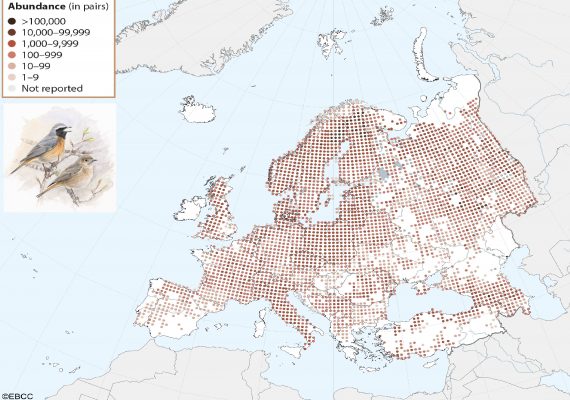
The European Breeding Bird Atlas is one of the most ambitious biodiversity mapping projects ever done. It documents changes in the breeding distribution of all European bird species and provides vital data for conservation.

EBBA2 covers 5 years of fieldwork in more than 50 European countries, including the European part of Russia, Caucasus, and Turkey, between 2013, and 2017.

EBBA Live, develops the project further with aim to update data on species’ distributions on a more frequent basis, ensuring that they are harmonised across Europe.

https://www.ebba2.info/

PanEuropean Common Bird Monitoring Scheme (PECBMS)

PanEuropean Common Bird Monitoring Scheme (PECBMS)

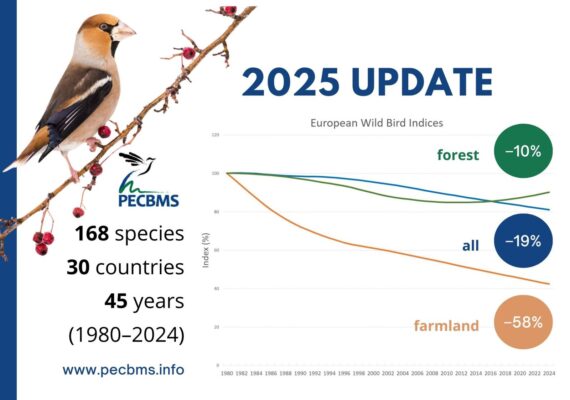
The main goal of the PanEuropean Common Bird Monitoring Scheme (PECBMS) is to use common birds as indicators of the general state of nature using large-scale and long-term monitoring data on changes in breeding populations across Europe.

See the last update of trends and indicators.
https://pecbms.info/

European Bird Portal (EBP)

European Bird Portal (EBP)

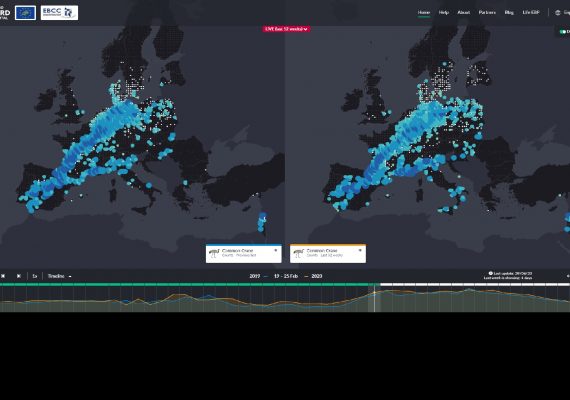
The purpose of the European Bird Portal is to establish a European data repository based on aggregated data from online bird recording portals from across Europe.

Mobilizing 100,000 volunteer birdwatchers and 50 million new bird records every year to unravel European-wide spatiotemporal patterns of bird distribution.

https://eurobirdportal.org/